Monthly Archives: July 2005

Werken and the New Zealand Pilot

New Zealand Pilot's Grave

The next stop on the tour didn’t have anything to do with World War One.
Werken has a historic Catholic Church with a “Way of the Cross” outside the
building around the outside of the cemetery and church grounds. The rain
had let up a bit, so I stopped as the Stations of the Cross are always
interesting. Do they stop with the crucifixion, or do they continue to the
resurrection? Unfortunately this one only had 7 of the prescribed 13
(though most stop at 12 and skip the resurrection), and like most Catholic
Churches and their Stations of the Cross, they stopped with the crucifixion.

But, two other things caught my eye! First was a small town memorial
erected in 1920 to the town’s sons who had died in the war. At the bottom
of the memorial were the words “Alles voor Vlaandren voor Christus” (All
for Flanders and for Christ). The letters AVV AVC (or AVV VVK) were often
arranged in a cross with the center V as the crux (see the Peace Gate picture at Diksmuide, or the view from the Peace Tower, for example). This phrase was
the rallying cry during The Great War for the Flemish separatists.

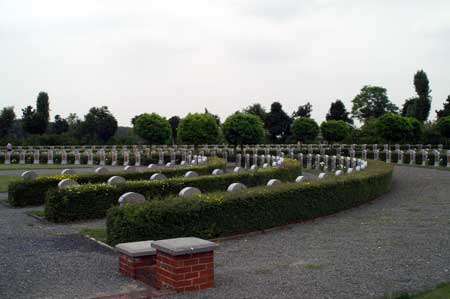
Secondly, at the entrance into the cemetery was the now-quite-recognizable
green War Graves Commission sign meaning that there are graves of British
soldiers in the cemetery. Since the guidebook I’m following had only to do
with World War One and made no mention of this cemetery, I looked for the
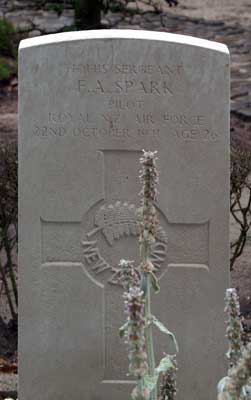
graves. I found a row of six graves, all airmen who died in 1941. One was
listed as being a New Zealand Air Force pilot. The rest looked to be bomber
crewmen. As I remember, the New Zealand Air Force provided fighter cover
for the British Lancaster bombers in the early days of the war. This fellow
died at age 26, someone’s son, buried a very long way from home.

It was only a brief respite. The rain has returned and it’s now really
coming down!

————————–

Sent from my BlackBerry Wireless Handheld
Vladslo German War Cemetery

Grieving Parents

A light rain has begun to fall and the sky is dark enough that pictures are
difficult to take. I’ve upped the ISO rating on the camera to 800, which
puts a little more noise into the digital pictures. The light rain and
somewhat gloomy skies match my melancholy mood for the time being.

This cemetery is the resting spot for almost 26,000 of the some 135,000
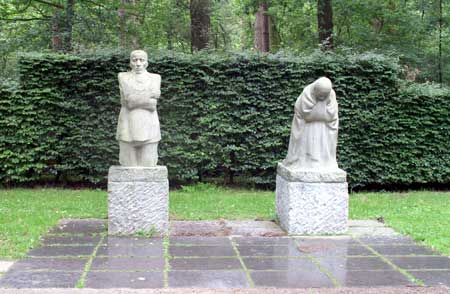
Germans who died in the war. The highlight of the cemetery are statues
of a mother and father grieving for their fallen son. Kaethe Kollwitz, a
well-known Berlin artisan, carved these statues in the likeness of her and
her husband in memorial to their son Peter, who was killed in Flanders on
October 23rd 1914 . These are very moving pieces of art and are placed
looking over their son’s grave.

The grave markers in the cemetery list the names of up to 20 soldiers on each marker, unlike British, American, and Belgian cemeteries where each person has an individual headstone.

————————–
Sent from my BlackBerry Wireless Handheld
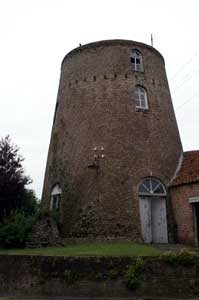
Kruiskalsijke Mill in Leke

The New Mill

The guidebook says: “Miller Vandedberghe had to look on while his
livelihood, the Kruiskalsijde Mill built in 1871, was dynamited by the
Belgian Military Engineers on October 17th 1914.”

At that time, the windmill stood quite tall with huge sails to catch the
wind and turn the grindstones. It also would have made a good lookout and
observation tower over the Ijzer plain. After the war the mill was rebuilt
using diesel rather than wind power. It now stands empty — almost
abandoned.

————————–
Sent from my BlackBerry Wireless Handheld
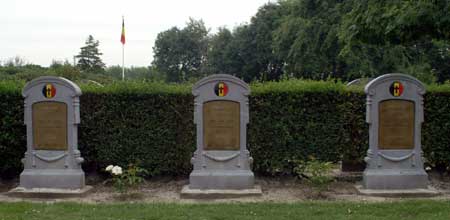
Back to Keiem

Unknown Soldiers

After finding that all good arrangements for Church fell apart, I decided
to complete the route that I left last night as darkness fell. So, I’m back
on the track at another Belgian Army cemetery, this one in Keiem (known as
Keyem in 1918). Most of the 628 graves in this cemetery are “Unknown”.
These are soldiers killed after a ill-planned and disastrous attack on the
Germans on 19 October 1914. The better armed and better trained Germans
decimated the Belgian troops, separated the soldiers from their officers,
and turned the area into a killing field. That was the last Belgian attempt
at making an offensive attack for the rest of the war.

Today Keiem is a peaceful farming community well off the main thoroughfares.
The railroad in this area was torn up and taken away about 30 years ago. It
now is a bicycle path that goes along the back of the cemetery. The cemetery
is also a quiet, peaceful place. Rest in Peace!

————————–
Sent from my BlackBerry Wireless Handheld
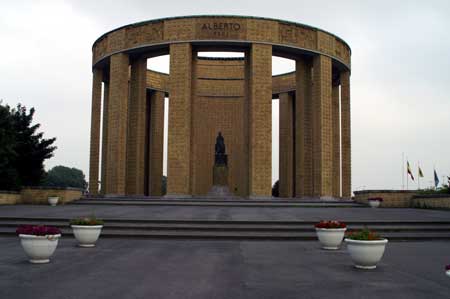
Belgium’s Knight-King Albert I

King Albert I

Albert, known here in Belgium as the Knight-King, along with his wife Elizabeth, were king and queen of Belgium as WW One began. Belgium had not joined either alliance and had declared itself neutral, as had Switzerland and the Netherlands. In the course of international politics, that had no bearing for the Germans. They demanded that Albert allow the German army to pass through Belgium on it’s way to France to do an end run around the French army which was stationed all along the French-German border. The Germans fully expected Albert to capitulate and were not pleased when he did not but rather mobilized the Belgian Army. The Germans struck first at Liege, a reasonably well fortified city, thinking they could quickly take that city, move through Antwerp, and west and south from there. Albert instructed his army to resist at all costs and what the Germans expected to do in two days took more than ten days at a significant cost of lives for the Germans. Meanwhile, the British Expeditionary Force was moving in to help defend Antwerp. The Belgian army fell back to Antwerp and defended that city as long as possible, then falling back again to the Ijzer River. Fortified by the British and some French, they made a stand there.

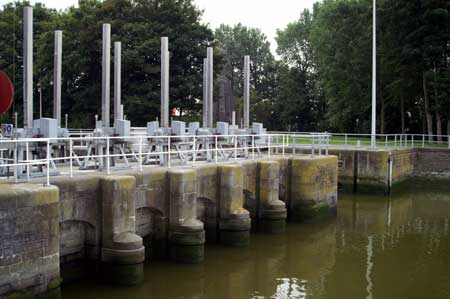
The Germans invaded Belgium on 4 October 1914. On 18 October they were finally at the Ijzer River, a full ten days behind their Grand Plan’s schedule. After seven more days of heavy fighting, the Belgian army was faced once again with the need to fall back. Then a brilliant plan was put forth. Much of this region was below sea level with locks and dikes holding the ocean back. Karel Cogge, the lock keeper, and Hendrik Geeraert, a sea captain, opened the locks so that at high tide the waters would flood the lowlands. It took a couple of days for the full flooding to occur, but it stopped the German advance. Meanwhile, the British and French had also stopped the Germans all along a line south into France. That line would more or less be maintained for the next four years.

The huge memorial to King Albert at Nieuwpoort commemorates the king’s role in this event. Albert was the commander-in-chief and was with his troops (or at least with his officers) during these battles and retreats and at his command the Belgian army was finally able to make a stand that lasted for the remainder of the war. Albert seems to be both venerated and scorned. His military actions earned him the veneration. His failure to keep promises to the Flemish people caused significant problems that lasted through WWII. By not following through on his promise to make the Flemish language equal with French, a near civil war occurred after World War One. That encouraged the Germans during WWII to make promises to the Flemish people, who by that time were all tired of being second-class citizens. Many Flemish dissidents collaborated with the Germans during WWII feeling at that time that the Germans were going to win the war and they wanted to be on the winning side. More than 200 collaborators were executed in the months following the end of WWII. That caused the dissidents to resort to terrorism which further inflamed the Belgian Government. Much violence and bloodshed could have been avoided if Albert had only kept his promise. Politics are never simple and this situation was no exception. The lens of hindsight makes the poor decision-making stand out while I’m sure the events of the day were clouding up everyone’s vision.

Just outside King Albert’s memorial is a large monument to the British soldiers killed in the defense of Antwerp. Around the monument was a very thought-provoking statement. It had essentially no beginning or end — it could just be read around and around. I wrote it down starting at an arbitrary point:

“At the going down of the sun and in the morning we will remember them. They shall grow not old as we that are left grow old. Age shall not weary them nor the years condemn.”

Nieuwpoort

The Dike

This is the place that caused the German advance to be bogged down. The dikes
were opened here flooding the lowlands along the river. The result was a
four-year-long stalemate broken when America joined the fray pushing the
Germans back and forcing the armistice (how is that really spelled?) and
the end to the war (but then setting the almost inevitable next war’s
stage).

I’m at a restaurant for dinner. I never stopped for lunch, and almost all
the restaurants here feature seafood. Being on the ocean and a popular
tourist destination adds to the demand for seafood. I wanted steak, so it
took a couple of stops in different restaurants until I found one that
features red meat on the menu. Even at that, rather than bread, they
brought some strange looking shrimp, probably cooked in something, still in
their shells. Along with them came an empty bowl. I tried to peel one, but
it just came apart. I’m not interested in whole tiny, cold, damp shrimp so
the small bowl full of them are just sitting there. I’ll let the waiter
take them away when he brings my meal.

I’m not even half way done on this tour. It’s 6:30 pm and I’ll be here
another half hour. There’s two more stops in this town, including a walking
tour around the locks, before continuing back south on the German side of
the line.

Since this was the sector assigned to the Belgians and they were supposed
to be neutral in this conflict (the Germans certainly didn’t care about
that), the Beligian army took essentially a “stop them and hold them”
stance. They did not attack or become the aggressors in the war at the
order of their then King Albert. My next stop is a monument to him.

Also, most of this tour has been about the Belgian involvement, told from
their viewpoint. I learned today some interesting things. At that time the
official language was French. The officers spoke French and had been
trained by the French. Most of the enlisted / conscripted ranks spoke
Flemish (a dialect of Dutch) and didn’t read or write French. That lead to
huge communication problems that were never really solved during the war.

There had already been a big separatist movement before the war. As these
dissidents were conscripted into the army, they began organizing the
soldiers and campaigning for equality of Flemish. Many were sent to jail
and a few were executed for insubordination, further exacerbating the
situation.

Meanwhile, on the other side of the line, the Germans were promising a
Flemish state under German rule, of course, in return for Belgian
cooperation, which was meet with disdain by dissident and loyal citizen
alike. The Germans were not light in their retribution, executing 10
Belgians for each act of supposed insubordination. So there was a kind of a
civil war going on under the umbrella of the larger conflict.

The meal has been good. Steak with a mushroom sauce, fries (of course), and
a pretty good side salad. The sky, which has threatened rain all day, has
brightened up a bit. I’ll at least visit King Albert and then decide what
to do after that.

————————–
Sent from my BlackBerry Wireless Handheld
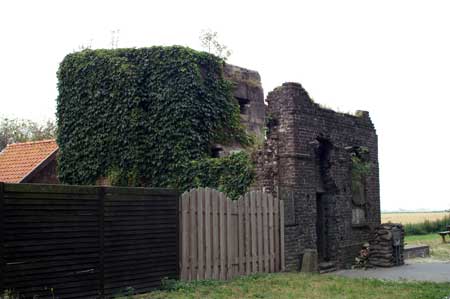
Ramskapelle

Remains of the Railway Station

This small town has two somewhat noteworthy items. At the entrance to the
town is the second of two demarcation posts (saying “Here the conqueror was
stopped”) that the Germans missed destroying during WWII. It’s also the
site of the only successful bayonet charge of the war (the French and the
Belgians counterattacking the Germans at the train station). After that,
trench warfare took over and machine guns ruled. Each year this town re-enacts the battle. For some reason each war starts off using the previous war’s weapons and tactics but then one side or the other quickly evolves.

————————–
Sent from my BlackBerry Wireless Handheld