After Duernstein, we cruised through lunch up the Danube River to the city of Melk. This city boats about 2,700 inhabitants and an incredible Abby of Benedictine Monks. 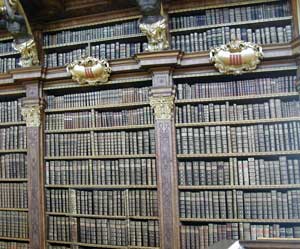 My command of English isn’t enough to describe this place, particularly the church in the Abby. I have never seen anything so ornate – to the point of being almost gaudy. The tour was centered on the Benedictine version of Catholicism, and I would have appreciated something much more historically focused. The major source of income for the Abby is tourism and about 450,000 people per year pay admission to tour a very small part of the Abby. The probably translates to some $5 million dollars a year just in entrance fees – perhaps more as I don’t know what the price of admission was. The library, having more than 150,000 books, was astounding. Anyone can come to the library, visit the reading room, and read any of the books. Those that are too old or fragile are on microfilm. The Abby has a current membership of 31 Benedictine Monks, 16 of whom live at the Abby. The rest are stationed at Parish churches around the country. I’d guess each of those 31 monks has available about 50 rooms apiece in the building. The Abbey is rectangular, three stories tall, with a large inner courtyard. Most impressive.
We set sail about 6:00 p.m. At the daily port call briefing at 7:15 p.m. (just before dinner), we learned that the boat has a propeller problem. While we were in Vienna, divers had gone down to inspect the bottom of the boat, the drive shafts, and the propellers. One of the propellers needs to be replaced. So, rather than sailing to Passau, our original destination, we are going to put into port in Linz about 7 a.m. We’ll go by bus to Passau after breakfast and spend the day there while the boat goes into dry dock to have the propeller replaced. If all goes well, we’ll be back sailing up the Danube on Saturday.
More on the propeller problem (added later, of course): The propeller had been damaged a couple of weeks before when leaving Melk on the previous cruise. The pictures of the propeller taken while the ship was in drydock and we were in Passau showed a very damaged propeller, so whatever had happened was serious, enough that the captain of the ship at that time had been placed on leave and a new captain assigned to the boat. As our cruise ended a week and a half later, we learned that replacing the propeller had fixed some of the problem, but that the drive train had also been damaged and the entire drive system — engine, transmission, drive train, and propeller — were going to be removed from the boat and shipped to Rotterdam for repair. The process sounded quite complicated!
When we got off the boat in Amsterdam, the ship was turning around for the final cruise back to Budapest. It was then going to Vienna and was going to do one-week trips between Vienna and Nuremberg through January 4th. A sister ship, the Viking Spirit, however, was also headed to Nuremberg to drop off passengers and then go idle for the rest of the season. The plan was, after the Spirit dropped it’s passengers, it would then sail to Vienna. The Neptune (our ship) would complete its cruise to Budapest, then sail back to Vienna. The Spirit crew would get on the Neptune and the Neptune crew would move to the Spirit. The Spirit would then finish the season in place of the Neptune. Meanwhile, the former Spirit crew would take the Neptune back to Linz where the boat would go into drydock once more. The drive train would be removed, sent to Rotterdam, and then reinstalled, a six week process. The previous captain of the Neptune had indeed done some serious damage when he grounded the boat in Melk. He would have been far better off getting a tug to pull them out in the deeper water…!!
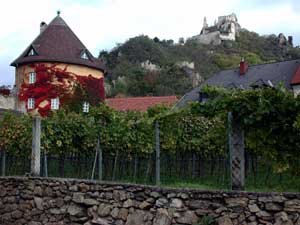 Our guides told us to be sure and remember it was a City and not a Village as Duernstein had obtained all the rights of a city, including the right to have an executioner, due to their loyalty to the monarchy during the 30-year war. It was a very quaint city well worth a visit. The city is built along a fairly steep hillside at a narrow point in the Danube River near the beginning of the Wachau Valley. The Wachau Valley is the source of an enormous amount of wine from vineyards all along the 20-mile long, narrow valley. The city was formed to collect tolls on the river and provide a way station for travelers (particularly royalty).
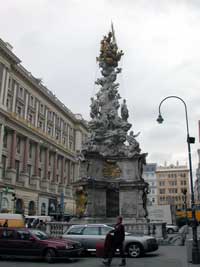 The morning was spent in a bus and walking tour of the central city. Even with that, we probably only saw a tenth or less of the area we were in. The picture accompanying this entry was taken near the city center and is of the monument erected to the plague that ravaged Europe in 1347 and 1348. About a third of the people in Europe died during this epidemic. Many cities pledged to erect monuments if the suffering would cease. This is Vienna’s monument commemorating the suffering of the plague.
 It was a very quaint town with a compact medieval center, where we spent most of our time. One of the gates into the city center had a big statue of Michael the Archangel slaying the dragon and overcoming evil, referring to the Book of Revelations. Further legend is that people are pulled down to hell by the weight of their sins.
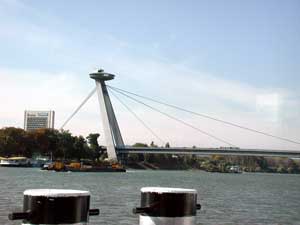
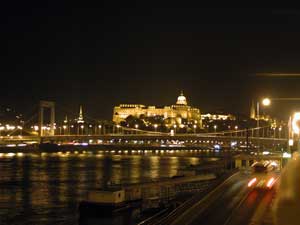 We’re headed towards Bratislava, capitol of Slovakia. We left the dock in Budapest right at 7:30 p.m. Monday evening (last night) while we were having dinner. The boat has been cruising up the Danube river ever since. It’s currently about 10 a.m. on Tuesday morning. Outside it is a beautiful, clear sunny day with temperatures of about 45 degrees. We passed through a lock about an hour and a half ago when we reached the first dam on the river. This was the first of sixty-eight locks on this cruise. We went into the lock while I was in the shower. It took about 20 minutes once we were in the lock for the water to fill up and raise the ship to the level needed to sail out of the lock. We’re now on a long reservoir feeding the power plant around which the lock was built.