Today was another day visiting two different cities. We stopped first in Mainz for a short walk around the city and then a brief visit to the Gutenberg Museum. 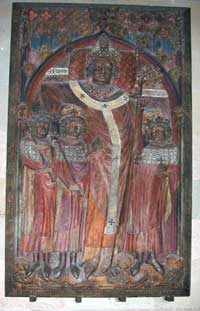 The museum is run with stereotypical Prussian German efficiency — everything seemingly timed by a stopwatch. Our city guide tended to be fairly wordy and got several reprimands from the staff because he was taking too long at the various stops on the tour thus making him late for the next appointed time. The museum was very crowded and that may have contributed to the urgency of moving people along with some speed.
Johann Gutenberg is known as the inventor of movable type. Prior to him, large wood blocks were carved and hollowed out and then inked and pressed onto paper. The task took a long time to prepare a wood block for printing and then the block would wear out or become ink soaked and thus unusable after several hundred impressions. Gutenberg was trained in metalworking, particularly in gold and silver. He took his knowledge of metalworking to invent a way to prepare uniformly sized metal characters that could be put into a frame and thousands of impressions made. Further, new or replacement characters could be quickly prepared and set into the form, hence the name “movable type.”
On display at the museum are one and a half Gutenberg Bibles, the first items to be printed with the movable type system. Gutenberg spent years working to perfect his invention and needed considerable financing. He took on several loans, the biggest of which came due while he was secretively printing this first run of bibles. The investor took him to court and won the lawsuit, including taking Gutenberg’s invention away from him. The investor Johann Fust completed the printing of the bibles and went on to make a fortune from this process. Gutenberg literally became anonymous and almost dropped completely out of sight. While he didn’t die bankrupt, he was only spared this circumstance because of the generosity of the Archbishop of Mainz who granted him a small pension and food ration.
This first run of 200 bibles resulted in 400 books — 200 Old Testaments and 200 New Testaments. According to our guide, about 40 or so of these bibles are known to be in existence. The museum in Mainz has two New Testaments and one Old Testament. The books were prepared in several stages. All of the pages were printed for a book. These pages were then sold to someone who took them to a bookbinder to be bound. After that, the owner would give the bound book to an illustrator who would decorate the pages and chapter headings in the book. About a year or so after buying the pages for the book a bound, beautifully illustrated volume was completed and ready for display. I think I need to look through our books one more time just to make sure we don’t have one of these million-dollar books hidden away somewhere….
Gutenberg’s invention changed the world, yet he had to sit on the sidelines and watch that happen. I think that television was also one of the world-altering inventions and Philo Farnsworth’s experience somewhat mirrors Gutenberg’s. In Farnsworth’s case, he invented TV, demonstrated the invention, and had it stolen by David Sarnoff, president of RCA. While Farnsworth also didn’t die in bankruptcy, he was certainly royally shafted by Sarnoff. The same has happened with other watershed inventions. James Watt, often credited as being the inventor of the steam engine certainly didn’t invent it — he figured out an important improvement and essentially took the feet out from under the original inventor, Thomas Neucomen. And then we have the saga of the personal computer and Bill Gates. Using a stolen piece of computer code, Bill Gates sold IBM an operating system for their new personal computer. Once the operating system contract was reached, Gates began the task of somehow acquiring the rights to the stolen code, which he finally obtained by bankrupting the owner and forcing the sale of the company. I’ve kind of decided that I’ll know when a world-altering invention occurs when nefarious characters peddling wares obtained by highly dubious and likely nefarious means accompany the invention. Oops, wait! Almost everything dealing with computers and high technology today is accompanied by the same hype and double-dealing (witness Oracle’s in-process rape of PeopleSoft).
The picture is from the Cathedral in Mainz. The carving shows one of the Bishops in Mainz depicted as the tall person in the middle of the picture. The three other folks aren’t children, they are kings. This particular Bishop had the opportunity to crown three kings and he is depicted almost as crushing the crowns down on the heads of the kings. In this part of the world, kings were elected by seven electors — three bishops and four patricians. Then one of the bishops would crown the king in that bishop’s cathedral.
After that whirlwind tour, we boarded the boat and sailed through lunchtime to Ruedesheim, a very quaint little city a bit further down the Rhine River from Mainz. The boat remained docked at Ruedesheim overnight since we would be sailing down the castle-rich, beautiful stretch of the Rhine River from Ruedesheim to Koblenz the next morning. The agenda in Ruedesheim included a visit to a self-powered musical instrument museum and then wine tasting in the Drosselgasse, a supposedly world-renown alley of wine bars featuring the wines of the Mosel and Rhine valleys.
The mechanical musical instrument museum was quite delightful. Music boxes of all types from small wind-up devices to huge merry-go-round machines were on display. A number of them were in working order and were demonstrated. The variety of music boxes and the ingenuity of the builders were amazing. Also on display were several Edison phonographs and recording devices. During the demonstration we learned the etymology of the idiom “Put a sock in it.” It seems as though the Edison phonographs were all LOUD and there was no volume control available. Rolling up one or more socks and tossing them into the horn controlled the loudness. Hence, telling someone to “put a sock in it” is to tell them to quite down. I haven’t heard that phrase for years, probably because very few people have to use socks as volume controls anymore. I bought a small device where I can “program” my own music strips to be played. I’m quite interested in seeing if I can make something happen.
We bypassed the Drosselgasse and instead had an apple strudel in a sidewalk cafe. The weather hopefully portended sunny, clear skies for the sail down the romantic Rhine River on the morrow.
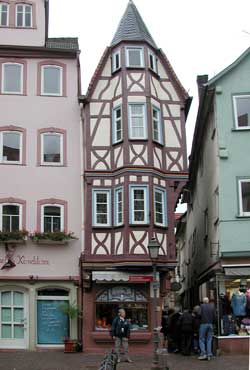 One impressive sight was the high water marks from floods over the past couple of centuries marked on a wall near the Tauber River. Once again, it was interesting to me that the city hadn’t done much to prevent the floods which happen on the average every three years. They did raise the level of some streets, but beyond that, people just have to live with the high water.
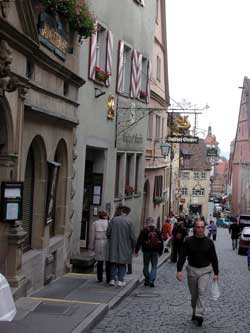 who was my boss back then. He had heard about this walled city and we drove over here from Munich one Saturday afternoon. I don’t remember much from that visit other than the walls and a new St. Martins Church. I haven’t found the church since then (but I haven’t looked too hard) but the walls are still here.
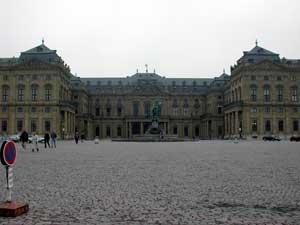
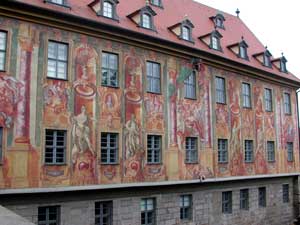 We spent a night and a day in Rothenberg on der Taube and had a delightful time (We’ll be in Rothenberg tomorrow) and then drove to Bamberg to spend the night and the next day. We didn’t find Bamberg to be so very interesting and about noon on our 1999 visit, left the city to go out in the countryside and then on to our next stop in Nuremberg. The write-up on Bamberg in our cruise itinerary sounded like a very different city than we had visited in 1999 so we were very curious to see what the guided tour of Bamberg would reveal.
 We would disembark there and use buses to complete the day’s activities, in reverse order. So, we got off the boat in Deggendorf about 9 a.m. for an hour’s bus ride past Kelheim and Regensburg to the Weltenburg Abbey. We arrived there late and really had to hustle through the Abbey. It was under reconstruction from the floods of 1999 and 2002 and 2003, so there wasn’t a lot to be seen, anyway. Abbeys, monasteries, and nunnery’s (convents) aren’t my first priority, anyway.