All posts by rksmith

Regensburg, Kelheim, and the Weltenburg Abbey

After the day in Passau, we returned to the ship which was now out of dry dock in Linz. We boarded the boat and began sailing up the Danube towards Regensberg. We wouldn’t get all the way there, so the plan was for the boat to make a brief stop in Deggendorf. RegensburgWe would disembark there and use buses to complete the day’s activities, in reverse order. So, we got off the boat in Deggendorf about 9 a.m. for an hour’s bus ride past Kelheim and Regensburg to the Weltenburg Abbey. We arrived there late and really had to hustle through the Abbey. It was under reconstruction from the floods of 1999 and 2002 and 2003, so there wasn’t a lot to be seen, anyway. Abbeys, monasteries, and nunnery’s (convents) aren’t my first priority, anyway.
The navigable part of the Danube river ends at Kelheim while the river itself continues upstream for a couple hundred miles. There are some day boats that traverse the river between Kelheim and Weltenburg — about a 45 minute boat ride up river and a 20 minute boat ride downriver — through some very scenic parts of the river. So, after a whirlwind 20 minute run-by, we left the Weltenburg Abbey and boarded one of the day boats for the trip downstream to Kelheim. Normally we would then have spent some time in Kelheim, but because of the change in plans, all we did was get off the day boat, board the busses, and then drove to Regensburg for lunch and the rest of the day.

The boat trip down the Danube was actually quite beautiful. The area is a National Park and only a few registered boats are allowed on this part of the river, so I guess a pleasure boat wouldn’t be able to traverse the area. In fact, we saw very few pleasure boats until we were near Koeln. I think it would be great fun to take a larger pleasure boat (one that you can live and sleep on) on this same trip and take a couple of months to make the voyage.

Regensburg was definitely a highlight of the trip. The city in the 12th and 13th centuries was enormously wealthy (along with all the attendant problems between church and state) because of its location on the major trade routes through Europe. The city was founded originally by the Romans in about 170 A.D. when a legion of soldiers was stationed there (a legion is about 8,000 soldiers!). Regensburg sits on the northernmost point on the Danube River and for several hundred years, the Roman Empire ended at this point. However, the Turks got quite ambitious in the 14th century, taking over most of Eastern Europe, including parts of Austria and all of Hungary. As a result, the east-west trade evaporated. Further, because of the Turkish presence, the north-south trade routes shifted much further west. In a few short years, Regensburg went from wealthy to bankrupt. That proved to be to the city’s benefit today as all of the old city remains. No one could afford to build anything new, so the existing structures were simply reused. Since the city was built upon trade and not on agriculture or manufacturing, it also escaped the bombing in WWII. There was no manufacturing there to be a target!

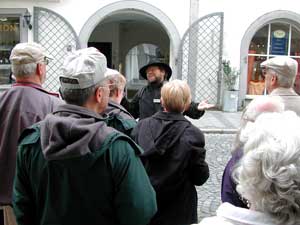
Our tour guide in Regensburg was originally from Missouri. He first came to Regensburg to teach at the University. After his five-year contract expired, he decided to stay (perhaps persuaded by his German wife) and be a tourist guide and a house husband. He was apparently well known. As we went on the almost 90 minute tour, he was greeted often by other people in the familiar form of German. We found him to be very knowledgeable and very interesting (as well as quite dramatic as seen in the accompanying picture).

There were a couple of very interesting features in Regensburg. First were the high towers. In the Regensburg Golden Age, wealthy business men would build a high, square tower attached to their house. The tower had no other purpose than to show wealth. Nothing was stored in the towers, they were just empty shells about four or five stories tall shouting to the world, "I’ve got so much money, I can just build this tower and I don’t really need it!" Of the more than 70 towers built, about 25 of them are still standing.

Secondly was the interesting history with the Jews. There was a large Jewish population in Regensburg and most of them were business partners with other non-Jewish business men. During the First Crusade (about 1100 A.D.) mercenaries and soldiers roamed through Europe killing any Jews that they could find. To "protect" their Jewish business partners, all the Jews were rounded up, taken down to the Danube, forcefully baptized, and then registered on the Church rolls. When the soldiers came through Regensburg, there were no Jews. About a year later, the ArchBishop declared the baptisms to be null and void, and everything returned to normal. That lasted until the city plunged into bankruptcy. Someone was certainly to blame, and the blame was fixed on the Jews. They were forcefully removed from the city, the synagogue torn down, and the Jewish cemetery razed. The tombstones were then used as decorations in houses! Some large number of Jewish tombstones can be seen around the town embedded into the walls of houses.

Finally, there is a very impressive bridge across the Danube River in Regensburg. This stone bridge was built by the Romans and survived wars, pestilance, plagues, and poverty. One span, however, did not survive the Nazi’s. They blew up one span as they were retreating. It has, of course, since been repaired.

We would definitely return to Regensburg. We only scratched the surface of what there was to see and do in this city. As we finished the day, we had some strudel and hot chocolate in a small konditori on the second floor of the old Salt House. Our cruise ship meanwhile sailed upstream from Deggendorf and met us in Regensburg. We were almost back on schedule.
Passau

The forecast for the day was partly cloudy and 56 degrees. The buses picked us up at 8:30 in very cloudy skies and a light drizzle. We’re now on the bus headed back to the ship under clear skies and 62 degree temperatures. So on average we had partly cloudy skies….
Passau

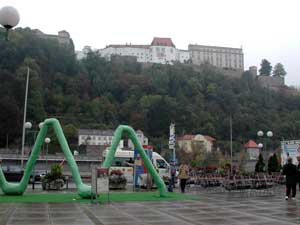
Passau is a border town between Germany, Austria, and the Czech Republic. Tourism is a major industry here with a million and a half day visitors per year and an additional 300,000 overnight visitors. The big business used to be salt. The local Prince-Bishop had a monopoly on the salt coming down the Ilse River from the salt mines to the south (Salzberg which, being interpreted means salt mountain). Salt was critical for food preservation in those days so Passau became a very prosperous city. Or rather, the Bishops became wealthy leading to a revolt by the townspeople. The Bishop’s residence (or Palace) was across the river up overlooking the town. To quell the revolt, the Bishop’s troops bombarded the city with cannons and firebrands! In one uprising some 25% of the men folk were killed, which was devastating to the town that had to care for all the widows. Eventually the townspeople prevailed and the Bishop lost his Prince title and rights. It’s quite amazing to me that the Bishop would war upon his congregation!

Passau is at the confluence of three rivers: the Danube which begins in the Black Forest in western Germany, the Ilse which begins in the Austrian Alps, goes through Salzberg and is the shortest of the three rivers, and the Inn which starts in western Austria and runs through Innsbruck (being interpreted is the Bridge over the River Inn). The Inn and the Ilse end at Passau and the Danube (which is Europe’s only west-east river) continues to the east. One or more of the rivers regularly floods the town with the last major flood in the spring of 2002.

Passau wasn’t the only town we went through that had problems with flooding. I’m not really sure what could be done other than building high dikes all around the town, which would certainly detract from the tourist trade. Perhaps they’ve just decided to “live with it.”

The Abby at Melk

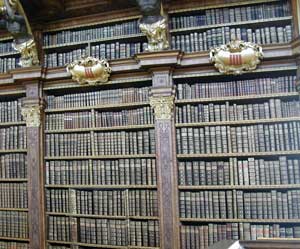
After Duernstein, we cruised through lunch up the Danube River to the city of Melk. This city boats about 2,700 inhabitants and an incredible Abby of Benedictine Monks. MelkMy command of English isn’t enough to describe this place, particularly the church in the Abby. I have never seen anything so ornate – to the point of being almost gaudy. The tour was centered on the Benedictine version of Catholicism, and I would have appreciated something much more historically focused. The major source of income for the Abby is tourism and about 450,000 people per year pay admission to tour a very small part of the Abby. The probably translates to some $5 million dollars a year just in entrance fees – perhaps more as I don’t know what the price of admission was. The library, having more than 150,000 books, was astounding. Anyone can come to the library, visit the reading room, and read any of the books. Those that are too old or fragile are on microfilm. The Abby has a current membership of 31 Benedictine Monks, 16 of whom live at the Abby. The rest are stationed at Parish churches around the country. I’d guess each of those 31 monks has available about 50 rooms apiece in the building. The Abbey is rectangular, three stories tall, with a large inner courtyard. Most impressive.
We set sail about 6:00 p.m. At the daily port call briefing at 7:15 p.m. (just before dinner), we learned that the boat has a propeller problem. While we were in Vienna, divers had gone down to inspect the bottom of the boat, the drive shafts, and the propellers. One of the propellers needs to be replaced. So, rather than sailing to Passau, our original destination, we are going to put into port in Linz about 7 a.m. We’ll go by bus to Passau after breakfast and spend the day there while the boat goes into dry dock to have the propeller replaced. If all goes well, we’ll be back sailing up the Danube on Saturday.

More on the propeller problem (added later, of course): The propeller had been damaged a couple of weeks before when leaving Melk on the previous cruise. The pictures of the propeller taken while the ship was in drydock and we were in Passau showed a very damaged propeller, so whatever had happened was serious, enough that the captain of the ship at that time had been placed on leave and a new captain assigned to the boat. As our cruise ended a week and a half later, we learned that replacing the propeller had fixed some of the problem, but that the drive train had also been damaged and the entire drive system — engine, transmission, drive train, and propeller — were going to be removed from the boat and shipped to Rotterdam for repair. The process sounded quite complicated!

When we got off the boat in Amsterdam, the ship was turning around for the final cruise back to Budapest. It was then going to Vienna and was going to do one-week trips between Vienna and Nuremberg through January 4th. A sister ship, the Viking Spirit, however, was also headed to Nuremberg to drop off passengers and then go idle for the rest of the season. The plan was, after the Spirit dropped it’s passengers, it would then sail to Vienna. The Neptune (our ship) would complete its cruise to Budapest, then sail back to Vienna. The Spirit crew would get on the Neptune and the Neptune crew would move to the Spirit. The Spirit would then finish the season in place of the Neptune. Meanwhile, the former Spirit crew would take the Neptune back to Linz where the boat would go into drydock once more. The drive train would be removed, sent to Rotterdam, and then reinstalled, a six week process. The previous captain of the Neptune had indeed done some serious damage when he grounded the boat in Melk. He would have been far better off getting a tug to pull them out in the deeper water…!!

Duernstein

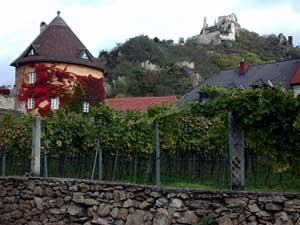
We arrived at the small town (400 souls) of Duernstein just as we sat down for breakfast this morning. Ruins of a castle overlooked the city. DuernsteinOur guides told us to be sure and remember it was a City and not a Village as Duernstein had obtained all the rights of a city, including the right to have an executioner, due to their loyalty to the monarchy during the 30-year war. It was a very quaint city well worth a visit. The city is built along a fairly steep hillside at a narrow point in the Danube River near the beginning of the Wachau Valley. The Wachau Valley is the source of an enormous amount of wine from vineyards all along the 20-mile long, narrow valley. The city was formed to collect tolls on the river and provide a way station for travelers (particularly royalty).
Duernstein’s major claim to fame is that this was the place where Richard the Lionhearted, King of England, was imprisoned and ransomed by England after about three months. Richard was one of several monarchs of Europe on the Third Crusade, but the only one to make it to the Holy City of Jerusalem. He managed to anger the Austrian Duke during the trip through Europe. On the way back to England Richard was shipwrecked near Italy and began making his way across Europe. While in Austria, he was discovered and taken hostage by the Duke. To keep Richard safe and away from public attention, the Duke quartered Richard in Duernstein. Legend says that Richard’s faithful servant searched from castle to castle through Europe singing the first verse of a song that only he and Richard knew. Upon singing the song in Duernstein, Richard heard it and sang back the second verse. The result was messages back to England and the ransom of Richard followed. Further, according to the story of Robin Hood, Richard’s brother John was attempting to have Richard declared dead in England so that John to assume the throne. Just in time, Richard appears, hale and hearty, and foils the plot.

The day began cloudy, but by the time we got to the city, the clouds were gone and a bright sunny (but chilly) day ensued. The weather was actually quite perfect for walking around the town and taking more than a hundred digital pictures. Perhaps a few will survive. The town was well worth our time.

Vienna

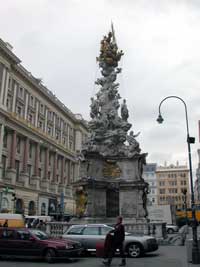
This is a beautiful city and one that we definitely need to visit again. We often don’t go back where we’ve been because there is so much that we haven’t seen, yet. ViennaThe morning was spent in a bus and walking tour of the central city. Even with that, we probably only saw a tenth or less of the area we were in. The picture accompanying this entry was taken near the city center and is of the monument erected to the plague that ravaged Europe in 1347 and 1348. About a third of the people in Europe died during this epidemic. Many cities pledged to erect monuments if the suffering would cease. This is Vienna’s monument commemorating the suffering of the plague.
I have learned a lot about the Hapsberg monarchy that I never really learned about before. Our tour guide was very well informed and quite passionate about her country, city, and heritage. I think that kind of passion causes learning to happen and knowledge to transfer.

It has been quite cold here today with a pretty stiff breeze. There were a few snowflakes falling earlier. The guide said it was unseasonably cold. Next time we come either in May or in September. The afternoon included a tour of the Schoenbrunn Castle. What a magnificent building. We had the “short” tour of 22 rooms. This castle, the so-called Summer Palace, should be on everyone’s agenda when visiting Vienna.

Tonight we’re going to a Mozart / Strauss concert. That should also be well worth our time. We’ll sail away from here about midnight.

Some thoughts:

The language on the Danube is German. All signs, instructions, and radio traffic is in German. This is a remnant of the Austrian Empire.

All of the buildings in downtown Vienna are four stories tall. None taller. I don’t know why.

There is construction everywhere downtown to renovate and extend the subway lines in preparation for the Soccer World Cup, which will be held in Vienna in 2008.

The UN has a huge facility on the other side of the river from downtown. Some 4,500 people work at the Atomic Energy Commission alone. No wonder it costs so much.

Later on in the evening:

The concert was absolutely delightful. It was kind of like a Mozart and Strauss Pops Concert – about 40 minutes of the most popular music from Mozart, a ten minute intermission and about 40 minutes of the most popular Strauss music, ending with the two most famous waltzes in the world: The Blue Danube and the Radizky Polka.

We were told in our initial briefing when we got on the boat to remember that other boats are on the river and sometimes boats tie up next to each other, so be careful about curtains when coming out of the shower or getting out of bed. Tonight as we were eating dinner, a boat came by right next to us maneuvering to dock behind us. Suddenly the dining room erupted in laughter — a fellow in the other boat had just come out of the shower, naked of course, with the curtains wide open. It took a few moments for him to figure out he was putting on a show. He waved, and ducked out of sight. The folks in the dining room are still chuckling about the incident.

Bratislava, Slovakia

The guidebook says that Vienna and Bratislava are the two closest capital cities in the world. They are about 50 miles apart. The town is quite small, about 450,0000 souls. BratislavaIt was a very quaint town with a compact medieval center, where we spent most of our time. One of the gates into the city center had a big statue of Michael the Archangel slaying the dragon and overcoming evil, referring to the Book of Revelations. Further legend is that people are pulled down to hell by the weight of their sins.
About 20% of the country’s population lives in Bratislava and that city accounts for about 26% of the gross national product. Housing was a problem until a large public housing project was put in place. Just on the outskirts of the city are a row of domino-looking apartment buildings housing 130,000 people!

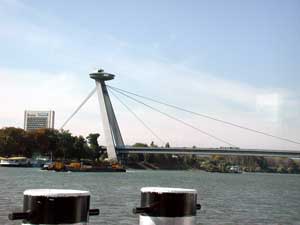
The city itself was clean and well kept. We did some shopping at a store selling folk art from all over Slovakia. We didn’t find similar stores in any of the other cities we visited on the cruise. I took mostly 35mm film pictures in Bratislava and will have to wait to get these pictures developed and scanned. Meanwhile, the picture the accompanies this entry is of the main bridge over the Danube River. There is a restaurant on the far side of the bridge built high over the bridge. Unfortunately, the restaurant is closed for renovation. There was a huge amount of construction going on in the city, perhaps because it is now the capital of the country and needs to get dressed up a bit. The US ambassador’s residence in Bratislava is built in the shape of the White House in Washington D.C. Slovakia is a very new country, or rather a re-establishment of on old country. It was formed anew in 1991 when the Czech Republic divorced them so they wouldn’t have to continue to subsidize the Slovaks. There isn’t much yet to recommend the city but I’m glad to have been there as we’ll probably never be back.

Leaving Budapest

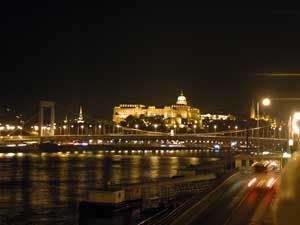
BudapestWe’re headed towards Bratislava, capitol of Slovakia. We left the dock in Budapest right at 7:30 p.m. Monday evening (last night) while we were having dinner. The boat has been cruising up the Danube river ever since. It’s currently about 10 a.m. on Tuesday morning. Outside it is a beautiful, clear sunny day with temperatures of about 45 degrees. We passed through a lock about an hour and a half ago when we reached the first dam on the river. This was the first of sixty-eight locks on this cruise. We went into the lock while I was in the shower. It took about 20 minutes once we were in the lock for the water to fill up and raise the ship to the level needed to sail out of the lock. We’re now on a long reservoir feeding the power plant around which the lock was built.

The server at home went down last Thursday. Of course there’s no way to do any repair work while we’re here in Europe. I’ll need to figure out how to be able to get these systems back up and running when I’m out of the house. That’ll be the project when I get back home. I’ll probably need to put in place different computers since a couple of them have to be switched back on manually when they loose power. That’s probably something I can’t do remotely! Because the server is down, I can’t post to my weblog. So, I’ll keep the weblog in this document until I get home and will then make the updates as though they had been posted as we went along.

Budapest was a delightful city and we spent a very good time there. We arrived on Friday in the mid-afternoon. Bobby and Duane’s flight from Amsterdam was about a half-hour late, but they also arrived without incident. I had a rental car arranged, but it wasn’t quite big enough to put all the luggage in the back. We probably looked pretty weird with luggage stacked everywhere. The map from Avis showed how to leave the airport and then showed the city with a big gap in between. Unfortunately, the information in that gap proved to be pretty crucial. We missed a turn that we should have taken and ended up wandering around in Budapest for a couple of hours trying to figure out how to get to the hotel. Even after stopping to ask questions twice, we were only getting closer without actually being able to arrive. I finally bought a detailed map of the city and we were then able to pinpoint exactly where we needed to be. It made for a very long afternoon, particularly for Bobby and Duane who had been up by that time for more than 24 hours.

Nina and I took the hotel shuttle bus into the city on Friday evening. We strolled down a walking / shopping street (Vaci Ut) and discovered at the far end a large group of restaurants. The weather was quite pleasant so we sat outside and had dinner. One of the deserts listed was noodles with poppy seeds. We couldn’t figure out how that could be a desert, so we ordered one to share. It turned out to be quite delicious. The noodles were round and fairly thick. Each noodle was about three quarters of an inch long and were a little sweet. The sauce was dark with a lot of cinnamon and sugar. Also included were a small pieces of fruit. It made a very good end to a very nice meal. By taking the shuttle bus into town and back to the hotel, we learned the way into the city, which allowed us to drive back and forth over the next couple of days.

Saturday morning two people that Duane had worked with in Hungary about six years previously met us – Eva and Monica. Eva’s husband Oscar came along as well. We drove through town and then about a half-hour north and a little west of Budapest to Szentendre. We visited an open-air museum there built to represent various areas of Hungary and the style of living over the years in each of these regions. We spent several hours there including eating a late lunch in the museum’s restaurant.

In the late afternoon we drive into town to do a little shopping and sightseeing. We went the other direction on the walking / shopping street and bought a few postcards. We then drove northwest out of the city through Tatabanya to the small town of Tata. When Duane and Bobby had been in Hungary some six years previously on business, they lived near Tata while Duane was working at a new plant in Tatabanya. Monica and Eva both worked at the facility as well and that’s how they came to know each other. Monica is about eight months pregnant with her second child. Eva is about three months pregnant with her first child. They were most gracious hostesses and we had a wonderful time with them.

Monica and her husband Tibor had recently built a home in Tata. We visited their new house and then we all went to dinner for another authentic Hungarian meal. The restaurant had great food. About 30 women who were having a class reunion populated the tables behind us – they were very loud!! That made conversation out our table difficult. We had a good conversation with Eva and Oscar but weren’t able to talk very much with Monica and Tibor.

We were not able to figure out where Church would be on Sunday. No one answered either of the two telephone numbers available to us. I did get an email from the Mission on Monday with a little bit more information, but still was insufficient to figure out where Church met. There are supposedly three Branches in Budapest meeting in three different chapels. The Mission and District could definitely use some help with publicity and Public Relations! So, instead of Church we drove downtown and verified where the Viking Neptune was parked, our boat-home for the next two weeks.

We packed up and left the hotel about 1:45 p.m. Avis wanted the car back! We drove to the boat and dropped off the luggage, Bobby, and Nina. Then Duane and I took the car back to the downtown Avis office. Finding anything in Budapest is an adventure. We had to ask three times for directions to find this place. What looks like a major street on the map often is nothing like what I think a major street should look like. The car rental office turned out to be down a narrow street that looked more like an alleyway in a gas station.

The boat is very nice. There are about a 150 passengers on the ship. Our room is on the right (Starboard) side of the ship on the middle level. The window is huge with a great view outside. The front of the ship has a large lounge with seating for all the passengers (most of them are here now as I’m writing this). A sun deck goes the full length of the ship upstairs. There is a restaurant in the back of the ship with seating for all the passengers as well. Breakfast is a buffet. Lunch has a salad bar and the rest is served at the table. Dinner is served at the table. The restaurant is open seating (no assigned tables). The food has been excellent.

Monday morning we were still docked in Budapest. We took a bus tour of the city including stops at Hero’s square (a breathtaking place) and then up to Castle Hill (where there is no castle). We really enjoyed getting an overview of the city and both Nina and I decided we could spend some time exploring the city on a future trip. We returned to the ship for lunch and then took another tour out to a horse farm for a show of Hungarian horsemanship. That was also quite fascinating. We enjoyed the drive out of the city and through the countryside. We were back to the boat about 5:30 p.m. We cleared immigration, had dinner, and were underway.

I’m really enjoying this type of a cruise. There is a lot to see – there’s always something along the shore to see. We’re coming up on a bridge in Bratislava in just a few minutes. Some of the bridges are going to be very low – such that everyone has to leave the sundeck and the wheelhouse hydraulics lower it into down to the ship so we can clear the bridge. There is another boat coming our way, so we’ve slowed way down as we approach the bridge.

Video Conferencing

I’m in the middle of another video conference with three countries. My feelings about video conferencing are not being improved by these meetings! We have this further complicated because all PC’s (including laptops) are pre-set with a time that they must go into lock mode requiring a password to unlock. The machine in this room locked a few minutes ago and we had to call someone in to type in the password. The solution is to wiggle the mouse every once in a while to reset the timers so the machine doesn’t go into lockup mode. Technology still plays too much a role in these meetings.

The weather here this week has been cloudy with occasional showers. It has also been fairly cool as well. The high temperatures have been in the low to mid 50’s. The weather is also moving east, unfortunately. We may have some wet and chilly weather as we start the cruise!

The time here in Belgium has been very pleasant. On Sunday afternoon after we arrived, we walked around the downtown area and mapped out several stores that Nina wanted to visit during the week. She’s slowly working her way through these stores along with a lot of sightseeing. There’s a very beautiful cathedral near the hotel (I’ve put several pictures of the cathedral on the pictures page) and she’s spent some time there with her camera. It’ll be interesting to see her pictures. I’ll be finished at work around noon on Thursday. We’ll make our way to Brussels that afternoon and spend the night at the Sheraton Hotel at the airport. By then the jetlag should be finished. One more good night’s sleep. I think.