All posts by rksmith

Koeln

Today was one of the best weather days we’ve had on the river. We stated with chilly temperatures and sunny skies then are ending with clear, sunny skies and warm temperatures. KolnNina got up early and was out on the front of the ship camera, at the ready. By about 10 she was bundled in her sweater, coat, and blanket. By 10:30 she had come into the lounge almost frozen, but with several (hopefully) great castle pictures.

We spent the night docked in Ruedesheim and set sail at about 7:30 along the most beautiful part of the Rhine river, past all of the castles built to extract illegal tolls and taxes on the river traffic. The trip was very pleasant and we arrived in Koeln (Cologne) at 3:00 pm.

I really enjoy the days cruising on the river. It’s kind of like a sea day on the big ships, except there is always something to see. We spent a lot of time on this trip sailing at night, meaning we couldn’t see very much through sleepy, closed eyes. We’ll go past Duesseldorf late tonight. I’d like to get up and see the town from the river!

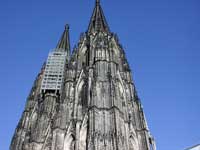
Koeln is still a fascinating city. The Cathedral is massive, one of the three largest cathedrals in the world. After all the others we have seen on this trip, the Koelner Dom just takes your breath away with it’s massive size and spectacular stained glass windows.

The infamous McDonalds is still there. That was the first McDonalds opened outside of Bravaria in Germany. When it opened, we took all the kids there on the train for Family Home Evening. The Germans in the Krefeld Branch thought we were crazy. I’ll bet we still have the tray mats from that visit!

We did a little shopping. I had to dial into a telephone conference at 4:00 pm about the 3rd quarter results. We sat in front of the cathedral watching the hoards of people walking past. The fine weather and a Friday afternoon seem to have brought the entire city! After we left the Cathedral, we walked down the pedestrian shopping street along with several thousand other souls. The size of the crowds certainly complemented the size of the cathedral!

Mainz and Ruedesheim

Today was another day visiting two different cities. We stopped first in Mainz for a short walk around the city and then a brief visit to the Gutenberg Museum. MainzThe museum is run with stereotypical Prussian German efficiency — everything seemingly timed by a stopwatch. Our city guide tended to be fairly wordy and got several reprimands from the staff because he was taking too long at the various stops on the tour thus making him late for the next appointed time. The museum was very crowded and that may have contributed to the urgency of moving people along with some speed.
Johann Gutenberg is known as the inventor of movable type. Prior to him, large wood blocks were carved and hollowed out and then inked and pressed onto paper. The task took a long time to prepare a wood block for printing and then the block would wear out or become ink soaked and thus unusable after several hundred impressions. Gutenberg was trained in metalworking, particularly in gold and silver. He took his knowledge of metalworking to invent a way to prepare uniformly sized metal characters that could be put into a frame and thousands of impressions made. Further, new or replacement characters could be quickly prepared and set into the form, hence the name “movable type.”

On display at the museum are one and a half Gutenberg Bibles, the first items to be printed with the movable type system. Gutenberg spent years working to perfect his invention and needed considerable financing. He took on several loans, the biggest of which came due while he was secretively printing this first run of bibles. The investor took him to court and won the lawsuit, including taking Gutenberg’s invention away from him. The investor Johann Fust completed the printing of the bibles and went on to make a fortune from this process. Gutenberg literally became anonymous and almost dropped completely out of sight. While he didn’t die bankrupt, he was only spared this circumstance because of the generosity of the Archbishop of Mainz who granted him a small pension and food ration.

This first run of 200 bibles resulted in 400 books — 200 Old Testaments and 200 New Testaments. According to our guide, about 40 or so of these bibles are known to be in existence. The museum in Mainz has two New Testaments and one Old Testament. The books were prepared in several stages. All of the pages were printed for a book. These pages were then sold to someone who took them to a bookbinder to be bound. After that, the owner would give the bound book to an illustrator who would decorate the pages and chapter headings in the book. About a year or so after buying the pages for the book a bound, beautifully illustrated volume was completed and ready for display. I think I need to look through our books one more time just to make sure we don’t have one of these million-dollar books hidden away somewhere….

Gutenberg’s invention changed the world, yet he had to sit on the sidelines and watch that happen. I think that television was also one of the world-altering inventions and Philo Farnsworth’s experience somewhat mirrors Gutenberg’s. In Farnsworth’s case, he invented TV, demonstrated the invention, and had it stolen by David Sarnoff, president of RCA. While Farnsworth also didn’t die in bankruptcy, he was certainly royally shafted by Sarnoff. The same has happened with other watershed inventions. James Watt, often credited as being the inventor of the steam engine certainly didn’t invent it — he figured out an important improvement and essentially took the feet out from under the original inventor, Thomas Neucomen. And then we have the saga of the personal computer and Bill Gates. Using a stolen piece of computer code, Bill Gates sold IBM an operating system for their new personal computer. Once the operating system contract was reached, Gates began the task of somehow acquiring the rights to the stolen code, which he finally obtained by bankrupting the owner and forcing the sale of the company. I’ve kind of decided that I’ll know when a world-altering invention occurs when nefarious characters peddling wares obtained by highly dubious and likely nefarious means accompany the invention. Oops, wait! Almost everything dealing with computers and high technology today is accompanied by the same hype and double-dealing (witness Oracle’s in-process rape of PeopleSoft).

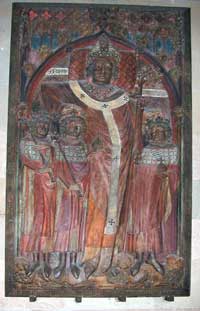
The picture is from the Cathedral in Mainz. The carving shows one of the Bishops in Mainz depicted as the tall person in the middle of the picture. The three other folks aren’t children, they are kings. This particular Bishop had the opportunity to crown three kings and he is depicted almost as crushing the crowns down on the heads of the kings. In this part of the world, kings were elected by seven electors — three bishops and four patricians. Then one of the bishops would crown the king in that bishop’s cathedral.

After that whirlwind tour, we boarded the boat and sailed through lunchtime to Ruedesheim, a very quaint little city a bit further down the Rhine River from Mainz. The boat remained docked at Ruedesheim overnight since we would be sailing down the castle-rich, beautiful stretch of the Rhine River from Ruedesheim to Koblenz the next morning. The agenda in Ruedesheim included a visit to a self-powered musical instrument museum and then wine tasting in the Drosselgasse, a supposedly world-renown alley of wine bars featuring the wines of the Mosel and Rhine valleys.

The mechanical musical instrument museum was quite delightful. Music boxes of all types from small wind-up devices to huge merry-go-round machines were on display. A number of them were in working order and were demonstrated. The variety of music boxes and the ingenuity of the builders were amazing. Also on display were several Edison phonographs and recording devices. During the demonstration we learned the etymology of the idiom “Put a sock in it.” It seems as though the Edison phonographs were all LOUD and there was no volume control available. Rolling up one or more socks and tossing them into the horn controlled the loudness. Hence, telling someone to “put a sock in it” is to tell them to quite down. I haven’t heard that phrase for years, probably because very few people have to use socks as volume controls anymore. I bought a small device where I can “program” my own music strips to be played. I’m quite interested in seeing if I can make something happen.

We bypassed the Drosselgasse and instead had an apple strudel in a sidewalk cafe. The weather hopefully portended sunny, clear skies for the sail down the romantic Rhine River on the morrow.
Wertheim

We were only in this charming little city for a couple of hours before lunch. The day was cloudy with occasional sprinkles and fairly chilly. Wertheim sits on the confluence of the Tauber River as it flows into the Rhine River. WertheimOne impressive sight was the high water marks from floods over the past couple of centuries marked on a wall near the Tauber River. Once again, it was interesting to me that the city hadn’t done much to prevent the floods which happen on the average every three years. They did raise the level of some streets, but beyond that, people just have to live with the high water.
Wertheim is also known for something else: Glass. The city didn’t become a center for glassmaking until the late 1970’s when Corning Glass put in a facility to make fiber optics. A number of glass blowers from Eastern Europe made their way out of the Communist Block countries to go to Wertheim where their skills could be well compensated. There are also several glass companies making decorative glass and we visited their retail store. We didn’t buy anything there because one of the glass blowers from that company would be on the boat in the afternoon demonstrating the art of glass blowing as well as bringing plenty of wares for sale.

Another important find in Wertheim was another big suitcase. By this time we had spent a LOT of money and had acquired a LOT of stuff that needed to go home with us. There was a small store selling somewhat poorly made, but sufficiently large and sturdy suitcases for 20 Euros. We bought one as did a number of other people on the cruise. It was kind of interesting watching the tourists making their way back to the boat towing a black suitcase behind them!

It turns out that all of the Galileo Thermometers are made in Wertheim! All of them. I bought one. It’s quite a unique instrument and will look good in our house in Pocatello. The glassblower who spent the afternoon showing us how some of the decorative glass in blown and prepared was very interesting. He spoke excellent English and was pretty full of himself as well. He certainly had a knack for handling glass, however. He sold a bunch of stuff after his demonstration. When we pulled into a lock, he and his fiancé hopped off the boat and were picked up by his father.

Lock-hopping, as it is called, was the means that we would catch up with the ship if we weren’t on board when it sailed. At the appointed sailing time, the ship left whether everyone was on board or not. We were given the phone number of the ship and if we missed it, we were to call the boat They would tell us what lock to meet the boat at and we would have to take a taxi there to meet the ship. As far as I know, we didn’t have anyone on the cruise have to do any lock-hopping.

Rothenberg ob der Taube

The bus leaves in about 5 minutes for the 90-minute drive back to Wuerzberg. We’ve had another delightful day in Rothenberg. The first time I was here was in the early 1970’s with Gordon Plummer, Rothenbergwho was my boss back then. He had heard about this walled city and we drove over here from Munich one Saturday afternoon. I don’t remember much from that visit other than the walls and a new St. Martins Church. I haven’t found the church since then (but I haven’t looked too hard) but the walls are still here.
The last time we were here we stopped at McDonalds for the restroom (there is always a clean, western toilet in a McDonalds). That place is now gone! I don’t know whether or not the restriction on buildings and allowable modifications (McDonalds was not able to display any “Golden Arches” on the outside of the restaurant) or just poor business conditions, but the restaurant is closed. There is no more McDonalds in Rothenberg!

The shopping was just as good, if not better, than it was in 1999. Nina shipped a whole bunch of stuff home and we’ll need to figure out how to send more as we don’t have room (or weight). I took a couple hundred pictures. Maybe I can make something from all the pictures?? I brought both my 35mm camera as well as the digital camera. I used the film camera in Budapest and found it too cumbersome, particularly when I can’t see what I’ve taken to decide if I need to take another one.

in the early 1950’s a group of 16 German towns along the Mainz and Tauber rivers banded together and formed the “Romantisces Strasse” organization. They pooled money for marketing with the intent of bringing tourism to the area. They built bicycle paths along the rivers, put signs up along the way, put together advertising for hotels and restaurants, and a very effective marketing program. The Japanese just love the idea and come by the hundreds if not thousands. They copied the idea and have established a “Romantisches Strasse” near Mt. Fuji in Japan. That association paid for putting Japanese language signs along the route in Germany and I think that every Japanese tour bus goes along this road. I think it represents one of the most effective marketing programs in Europe, as tourism is the number one money producer for the region with wine ranking number two. I’m sure that the tourism helps enormously with the sale of wine.

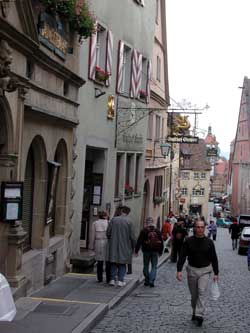
Rothenburg is also known as "Christmas Town" as one of the major businesses in town is a year-round Christmas Store, Kaethe Wolfart. When we were in town in 1999 we spent a significant amount of money on Christmas tree ornaments. We did the same this time. Kaethe Wolfart has been able to extract a lot of money from our wallet — but all for a good cause. Another reason we like this town is that good quality souvenir products are available from all over southern German. There are enough tourists that quality merchandise has a good market in the city. I suspect that during the summer, the population doubles every day with all the tourists that arrive, spend money, and then leave.

Wuerzberg

We’re just leaving Wuerzberg headed southeast to Rothenberg along the “Romantisches Strasse”, the Romantic Highway. It’s quite foggy so there isn’t much visible a few feet away from the bus. We’ll be driving for about an hour.
Wuerzburg

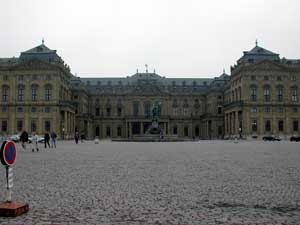
The first stop was the Bishop’s Palace in Wuerzberg. That place is one-upmanship personified. The area the Wuerzberger Bishop ruled over was smaller than some of the neighboring Bishops. To make sure that the other Bishops didn’t get idea that Wuerzberg was weak or poor, he built a massive, intimidating Bishop’s Palace. Much of the building was destroyed in a bombing raid in March 1945. The furnishings and whatever else could be removed had been taken out of building a couple of years earlier for safekeeping. The building restoration was completed in 1984 along with the stuff that had been kept safe.

Like many of the other cities we’ve visited on this trip, the Bishop was also part of the royal family so he had both religious and political power. That also occasionally conflicted with the Mayor and local businessmen. One the first Prince-Bishops was so disliked he was killed and thrown in the river. Bishops were elected by the elders in the church from among their number and then served for life, much like the Pope is selected. Mayors were also elected from among the businessmen of the town and served for a fixed term.

Since to find the seat of power you just have to follow the money, having two powerful men and institutions in the same small area has to lead to conflict and the common person usually ends up the worst for it. After the first Bishop was killed, the Church built a castle on the hill overlooking the town. As in Passau, a couple of conflicts resulted in the town being bombarded with cannon fire from the Bishop’s Castle!

Eventually by the late 1600’s the tensions were resolved enough for the Bishop’s Palace to be built in town. The palace was completed in 1742. In 1809 the French led by Napoleon arrived and forced the Bishop to resign. That was the end of the Bishopric in Wuerzberg. The biggest and most opulent, decadent buildings are built and occupied just before the fall and “great is the fall thereof.”

Bamberg

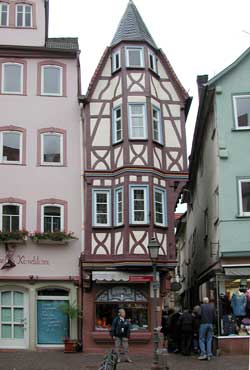
This is our second visit to Bamberg. We put this city on our agenda in October, 1999 when Nina and I were in Europe on vacation following a business meeting in Munich, Germany. BambergWe spent a night and a day in Rothenberg on der Taube and had a delightful time (We’ll be in Rothenberg tomorrow) and then drove to Bamberg to spend the night and the next day. We didn’t find Bamberg to be so very interesting and about noon on our 1999 visit, left the city to go out in the countryside and then on to our next stop in Nuremberg. The write-up on Bamberg in our cruise itinerary sounded like a very different city than we had visited in 1999 so we were very curious to see what the guided tour of Bamberg would reveal.
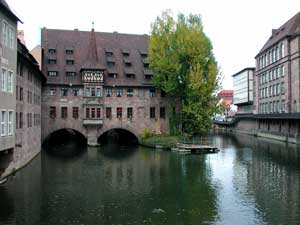
We docked in Bamberg right about 11 a.m. this morning after cruising the rest of the Rhine-Main-Danube Canal. It was a pleasant morning. I spent it in the lounge classifying digital pictures that will eventually end up on the web page. After lunch we disembarked for a short bus ride to the center of the city where we met our city guides. We stayed with our guide until the start of the climb up the hill to the cathedral. We’ve already been there and didn’t want to make the climb again. Besides, the stores were open and we wanted to do a little shopping. It is still the same city. Our tour guides did not reveal anything new or show us anyplace that we hadn’t already visited. It was a bit more interesting today only because we haven’t yet been to Rothenberg….!!

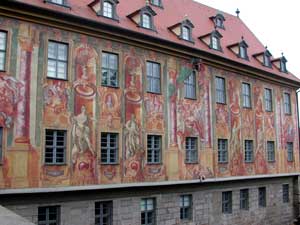
Bamberg is a very old city on a trade route made possible by the Main River (pronounced “mine”). Similar tension existed here between the Bishop of the Catholic Church and the Mayor and citizens of the city. This tension has been a very common theme in Passau, Regensberg, and now Bamberg. At least in Bamberg the Bishop didn’t make war on his congregation as he did in Passau. That tension still exists to some extent in Regensberg where the guides employed by the city’s tourist bureau aren’t allowed to take tourists into the cathedral. The general architecture in Bamberg is buildings made first of big criss-crossing timbers, then the spaces between the timbers filled up with a plaster. Then, because wood timber houses were considered to be “cheap” houses, most were then plastered over, and in some cases, painted to look like stone buildings.

Bamberg is also a U.S. Army city. About 4,000 soldiers are stationed in Bamberg and about a thousand of them are currently in Iraq. When we lived in Germany in the mid-1970’s, there were more than a quarter of a million U.S. military personnel and their families in Germany. In 1992 a large drawdown started and there are probably less than 30,000 U.S. military in the country now. Bamberg serves as a logistics and supply center and was once very strategic in its position relative to East Germany. Today’s world situation is significantly different and Bamberg’s usefulness has certainly diminished and perhaps even disappeared. However, the Army presence makes a significant contribution to the local economy and that has become quite important to the Germans. In the 1980’s they couldn’t wait for us to leave. Then when the drawdown started and we actually began leaving, the economic impact became very visible and painful. Now folks aren’t as anxious for the troops to leave….

After we ditched the tour, we spent some time window shopping and actually buying a few things. We visited a store selling antique Christmas Creches (manger scenes) and we did spend a little money there. The big shopping (if any of it can be considered to be “big”) will be tomorrow in Rothenberg.

Nuremberg

We arrived in Nuremberg shortly before noon and disembarked at 1:30 for a driving / walking tour of the town. The day was quite cloudy, a bit breezy, Nurembergwith some fairly hard rain showers in the late afternoon. Then the skies cleared up and sunshine appeared just as we were leaving town to go back to the boat. The day was very pleasant and much less hectic that the previous two days. It was good to have some downtime!

Nina and I were in Nuremberg in October 1999 for a couple of days and did some sightseeing when we were here then. We ended our visit on a Sunday, so it’s quite nearly five years to the day when we were in this town last. Based on the tour, we saw almost everything the first time that we saw today, so we skipped the walking part of the tour. On the way into town we stopped at the Zeppelin Field on the southeast part of the city were the huge airships started and ended their transatlantic flights. It’s pretty hard to imagine an airship flight across the Atlantic, and I’ve been quite curious as to why no one has attempted to do this since then. It would certainly be much safer today than it was in the 1920’s! The National Socialists (the Nazi Party) transformed the Zeppelin Field in the 1930’s into a rally field where hundreds of thousands of Germans would gather to hear Hitler speak. Perhaps some of the most famous large-gathering pictures of Hitler were taken at this place. Today the huge concrete buildings still stand and not much is being done with them. From there we drove to the west side of the city to visit Court 600, where the famous Nuremberg war trials were held from November 1945 through October 1946. The building was closed (being a Sunday) so we stopped long enough to take some pictures outside the building and then proceeded through the center part of the town and up to the castle overlooking the city. That’s where we parted company with the walking tour as we have already been there.

However, almost everything was closed in the city. We did some window-shopping, visited a couple of churches, and had an apple juice in a coffee shop while it was raining. Then we met the bus for the ride back to the boat.

After dinner the cruise staff had booked some German entertainment – a couple of fellows with an accordion and a guitar singing some good old German folk and polka music. It was great fun. The day is now finished and we’re headed for bed.

Tomorrow we’ll be cruising the last part of the Rhine-Main-Danube Canal to Bamberg and will arrive about noon. We didn’t think much of Bamberg the last time we were there, so it’ll be interesting to see what we’ll learn from the walking tour.

Canals

Canals between the Rhine River and the Danube were long envisioned and achieved only with difficulty. The vision was a water highway extending from the North Sea at Rotterdam, Netherlands to the Black Sea. This water route could be traversed in about a third of the time it would take for a sailing vessel to go through the Mediterranean Sea. The first canal, the Rhine-Rhône, was built between 1784 and 1833 and is now largely abandoned. The main driver for this canal was to build a Freedom Monument in Kelheim and then to encourage trade along the river. The current canal, called the Rhine-Main-Danube Canal, took more than 30 years to complete. The first section, from Bamberg to Nuremberg was completed and then funding was withdrawn by the German Government because of the change in political fortunes and environmental concerns. It took 15 years before work started once again, after all the planning was reworked with the intent of making the canal look more like a river than like a canal. There are 34 locks on the canal to lift boats up and over the several hundred feet of elevation that must be traversed. Some of the locks are very deep — and two of them are more than 80 feet.

Locks were very interesting on the trip. We went through a total of 68 locks on the cruise, meaning that the ship spent more than 35 hours of cruising time traversing locks. We often had to wait for another boat to come out of a lock before we could go in. From Budapest to about the middle of the Rhine-Main-Danube Canal, we went up at each lock. We would sail into the lock, the doors would close, water would be let into the lock and lift the boat up to the next level. The front doors would open and we would sail out. Then another boat would sail in going down and reverse the process. On the Danube and Rhine Rivers, no pumps were needed for the locks as water was flowing downstream. On the canal, however, the water had to come from somewhere. So each of the locks also generate electricity as the water is let out of the lock. That electricity is used to pump water from the Danube River up to the highest stretch of the canal. That water is then flows downstream from that point to make the locks work.

On the Rhine and Danube, all the locks were associated with power-generating dams. On the Rhine-Main-Danube Canal, the locks were used to get boats up and over the hills separating the Danube Valley from the Rhine Valley. It didn’t take long before locks became old and boring, made even more so as I would always loose my wireless connection when we went through a lock. Since we went through most of them at night, it was quite often the case that I’d be checking e-mail before going to bed or before going to breakfast and we would sail into a lock.

The economics of the Rhine-Main-Danube Canal are still being debated. It was originally going to take six years and cost about 200 million Euros. In the end, it took more than 15 years and cost more than 6 billion Euros. The canal was opened in 1992 to great fanfare. It was already too narrow when it finally opened and the six-day journey in smaller cargo ships on the canal compared to a sixteen-day journey in huge cargo ships on the Mediterranean makes for difficult economics. The number of cargo boats on the Danube River was about a third of the number on the Rhine River. Right now it looks like the Mediterranean is winning. However, now that Eastern Europe is beginning to thrive, trade along the Danube will become much more important as every major Eastern European city found in Germany, Austria, Hungary, Slovakia, Romania, Bulgaria, Moldovia, and Bulgaria are all either on the Danube River, or on major rivers that flow into the Danube. So, the canal may yet turn out to be fortune rather than folley.