All posts by rksmith

Ramskapelle

Remains of the Railway Station

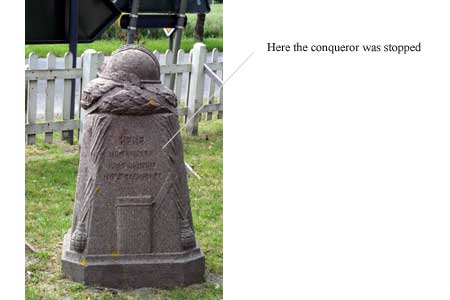
This small town has two somewhat noteworthy items. At the entrance to the
town is the second of two demarcation posts (saying “Here the conqueror was
stopped”) that the Germans missed destroying during WWII. It’s also the
site of the only successful bayonet charge of the war (the French and the
Belgians counterattacking the Germans at the train station). After that,
trench warfare took over and machine guns ruled. Each year this town re-enacts the battle. For some reason each war starts off using the previous war’s weapons and tactics but then one side or the other quickly evolves.

————————–
Sent from my BlackBerry Wireless Handheld

Demarcation Post

Demarcation Post

I parked by the side of a bicycle path and walked a half-mile (each way) to
Old Stuivekens. The town has been relocated about a mile and a half onto a
more main road when the railroad track was taken up in the mid-70’s.
Remaining is a small church, Chapel of Notre Dame of Victory, and the base
of it’s bell tower. The tower was an observation post for the Belgian Army
until German artillery took the tower down.

The notable item, however, was a small stone pillar on which was carved in
Dutch: “Here the conqueror was stopped.” Very few of these markers remain.
During the German occupation during WWII, special units were commissioned
and sent out to obliterate any monuments to the German defeat in World War
One! They missed a few, and this was one of them.

————————–
Sent from my BlackBerry Wireless Handheld

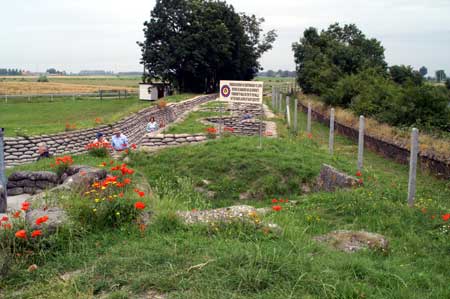
The Trench of Death

Trench of Death

This area north of Diksmuide was strategic during the early part of the
war. Several very large oil tanks stood in the middle of no-mans-land and
both the Germans and the Belgians (who were assigned this part of the front
to defend) began trenching towards the tanks. Neither side attained the
objective. When the Germans realized they couldn’t get there, the tanks
were shelled and destroyed. Before that, however, both side took heavy
casualties while digging the trenches at night and defending them during
the day. Hence the name: the trench of death.

————————–
Sent from my BlackBerry Wireless Handheld

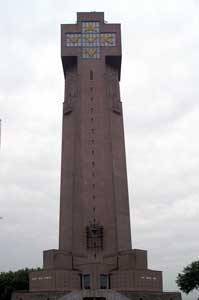
Peace Gate

The Peace Tower

Two hours later and I’m just on the outer edge of Diksmuide, stop #4. I
don’t know where 2 and 3 are — the street was closed and it took a bit to
circumnavigate the closed area. I either need a navigator or a driver! It’s
sometimes hard to do both.

The Peace Gate includes a tall 84 meter tower, 22 floors. It turns out the
elevator goes up, but you have to walk down as the museum is on the floors
as you descend. I’m pretty sure there was information about this, but not
in English! While some of the museum was about the two wars, most was
dedicated to the Flemish separatists who were striving for an independent,
Dutch speaking state. While the history was somewhat interesting, there was
very little in English (not surprising considering the subject matter). So
— on to the next stop: Death Passage.

————————–
Sent from my BlackBerry Wireless Handheld

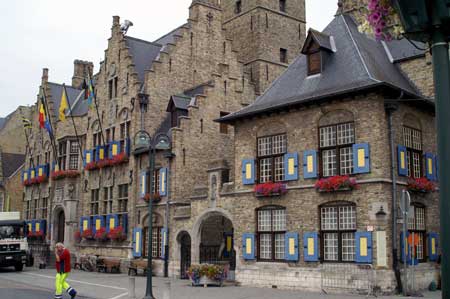
Diksmuide

Diksmuide Town Hall

I’ve now started the Yzer Front tour of significant places during World War
One. This is another town on the front lines completely destroyed even
though it was never occupied. The town sits on the Ijzer River, now a
popular location for luxury yachts well protected from the sea. During The
Great War, the Belgians flooded the Yzer plain blocking the German advance.
This 48-mile driving tour today goes along the river on both sides with
many stops along the way at points of interest.

Getting here was a bit of an adventure. I needed gas and nary an open
station was to be found. Many would take a credit card 24 hours a day, but
only with a PIN number. My PIN from the US wouldn’t work. I stopped at
several stations trying various cards without luck. Finally, with the car
making lots of ringing bells and chimes to tell me that I’m running out of
gas, I saw a fellow inside a closed station. I was able to convince him to
come out and sell me 50 euros cash of gasoline. I’m now good to go for the
rest of the day.

————————–
Sent from my BlackBerry Wireless Handheld

Travel Adventures in Belgium

Since the train runs between Kortrijk and Oudenaarded, and Friday was a day where very few people would be at work, I decided to take the train rather than drive. Getting to Oudenaarde was no problem, except the train schedule didn’t seem to be the real train schedule. The schedule listed a train at 7:47, but there was no train. The one scheduled at 8:08 turned out to be at 8:06 instead. But with all that, there was no problem with the trip. It was fast, much easier than driving. It took about 10 minutes to walk from the hotel to the train station in Kortrijk, the actual train ride was about 25 minutes with two stops, and another 15 minutes to walk from the train station to the office.

Before I left the station in Kortrijk, I checked to see what the schedule was to return. It said there was a train on normal days at 2:28 p.m. or on weekends and holidays at 2:29 p.m. The next train was an hour later. I decided I’d leave the office at 2, catch the 2:20-something train, and all would be well. As luck would have it, I didn’t get out of the office until 2:10, so I really hiked down to the station. There were several tracks, and each had a train. Which one went to Kortrijk? I went up on the platform that I arrived on and asked a person. He told me this was the train to Kortrijk. I should have asked someone else! It turns out he spoke French and didn’t understand me for sure because the train went south instead of west and I ended up in Ronse instead at the next stop. So, here I sit on the train headed back to Oudenaarde. I’ll now be on the 3:20-something train. I should have enough time to ask the station master which train to take this time. I’ve got a telephone conference at 4:00 p.m. and I’ll be late. I forgot to bring my Blackberry with me today — it’s sitting on my bed waiting for me to put it on my belt! So, I’ve no way to call into the meeting until I’m back at the hotel room. Dang.

It’s now 3:29 and I’m on the train to Kortrijk from Oudenaarde. The train left a minute ago and I’ve verified with a couple of folks that this is the right train. It’s going a different direction than the last one, so that much is good. It’s a very cloudy day, so there are no shadows to indicate which direction we are going.

We’re going past the nuclear power plant, so we’re definitely headed in the right direction. The countryside is very pretty and very European. Lots and lots of small farms with multitudes of cows. I think that most of the farming must exist to feed the cows. The farms are generally well kept and tidy; a far cry from many of the farms in the back roads in southeastern Idaho. Almost every house that has a back yard coming up to the train tracks has a garden growing vegetables of some sort. Very few have grass in the back yard so it’s definitely more for growing things. Once I get to Kortrijk, I’ll have to hurry to the hotel. Perhaps there’ll be a taxi close by that I can take. It might be worth it.

This train moves quite fast between stations — faster than I’m allowed to drive on the highway. That’s probably why the train gets there more quickly, even with the stops. We’ve passed a couple of windmills — somewhat different than those in Holland but still windmills. I think I need to build one and start generating some electricity. Perhaps I can use the electricity to put pathway lighting in, or to put some lights in the back yard around the fence.

This must be more of an express train. We’ve passed a couple of stations where we stopped this morning. It’s time to put the computer away as we’re fairly close to Kortrijk! At this rate I’ll have plenty of time to walk to the hotel. It took only 14 minutes to go from Oudenaarde to Kortrijk. The fastest I’ve driven is 28 minutes — or twice as long.

Well, I’ve arrived at the hotel in plenty of time for my meeting. I could even answer a couple of e-mails!!
The Afternoon In Ieper

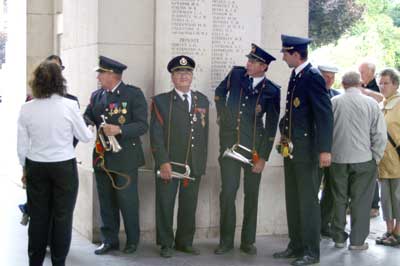
Ieper Buglers

It’s just 10 pm and I have just gotten to my hotel room. I stayed in Ieper (I learned from the material that the British call it “Wipes”) and had dinner there — pepper steak (with fries, of course). Also in the material was info about a group of Ieper buglers who perform “Last Post” at 8 pm. I got to the place about 7:55 and while I could hear them, the huge crowd meant I couldn’t see them. I probably needed to have been there about 20 minutes earlier. It was nice, however. The British built a huge war memorial to all those whose remains were not recovered. The “Menin Gate” goes over the road on the way into the center of town. The gate is about 50′ tall, three lanes wide, and about 100′ long inside — kind of like a tunnel. Inscribed on all the walls are about 55,000 names of the missing. The buglers stood inside the gate so their sound echoed in the gate. Quite impressive.

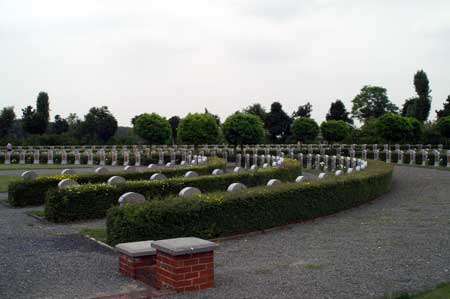
On the way out of town headed back to Kortrijk, I passed several more British cemeteries but didn’t stop until I saw a sign for “The Scottish Stone”. For that I turned off the road. First, I found another big British monument to a group of “miners” who were killed underground. These were tunnel builders who would tunnel underneath German lines and plant huge caches of explosives (mines) which would be blown up at the start of an attack to open up ways though the lines. Very interesting. My brochure talked about an attack that started with 21 tunnels and mines being laid. “They ended in small rooms where thousands of kilograms of explosives were brought. Two of the 21 mines did not explode; the 20th mine exploded during a thunderstorm on July 19th 1955. The last mine is still keeping it’s explosion a secret.” One of these craters is now a park called “The Pool of Peace.”

A bit further on was the memorial to the Scotts for an ill-fated charge in which 2/3rds of them were killed.

From there it was back to the hotel for the night. A very interesting day!

————————–

Sent from my BlackBerry Wireless Handheld